National 26 August, 2026Raksmey Hong
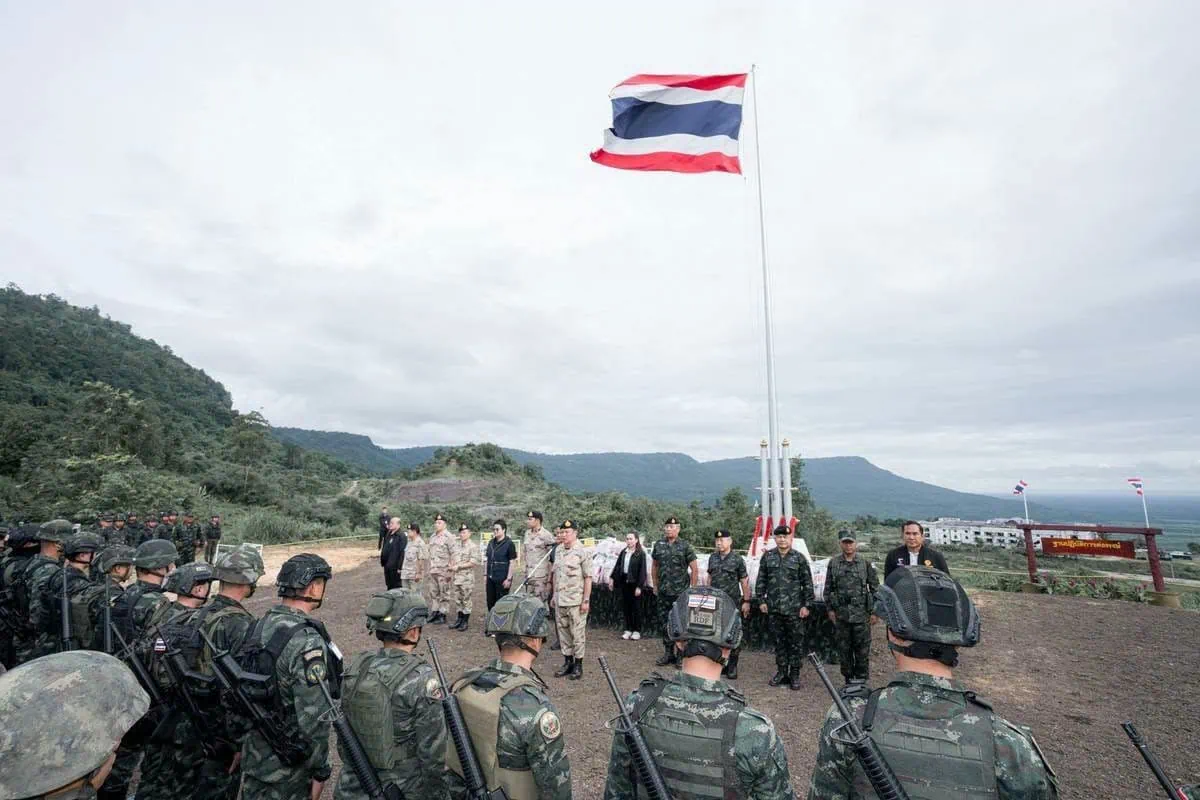
A Thai national flag flies over the An Seh area as Prime Minister Anutin Charnvirakul addresses Thai troops during his August 23 visit. Cambodia protested the visit as unauthorised, maintaining that the site lies within Choam Ksan district, Preah Vihear province. Supplied
Share
Cambodia has lodged its “strongest protest” yet against Thai Prime Minister Anutin Charnvirakul, for his visit to the An Seh area in Preah Vihear province, accusing Bangkok of attempting to legitimise its territorial claim over land that Phnom Penh says has been illegally occupied by Thai forces since last year.
In an August 25 press release, the Ministry of Foreign Affairs and International Cooperation said Anutin visited An Seh, in Choam Ksan district, on August 23 without Cambodia’s authorisation.
The ministry described the visit as a deliberate attempt to assert an illegitimate claim over Cambodian sovereign territory, amid continuing tensions and competing accounts of the situation along the two countries’ shared border.
“The unauthorised visit constitutes a deliberate attempt to assert illegitimate claims over Cambodia’s sovereign territory — an area that has been illegally occupied by Thai armed forces since last year,” the ministry said.
It argued that no lawful territorial entitlement could result from an act that Cambodia considers illegal.
“No legal right can arise from an unlawful act; therefore, the illegal occupation of Cambodia’s sovereign territory cannot be legitimised by a visit from the Thai prime minister,” it added.
Cambodia maintains that An Seh lies inside its internationally recognised territory, as defined by the 1:200,000-scale maps produced by the commissions established to delimit the boundary between French Indochina and Siam.
Thailand has historically challenged Cambodia’s reliance on the maps in several disputed sections of the frontier and uses different interpretations of the watershed and boundary lines. The competing positions have repeatedly caused tensions between the two neighbouring countries.
The ministry said neither a map drawn unilaterally by Thailand nor a high-level visit based on such a map could alter the internationally recognised boundary.
“The Royal Government of Cambodia re-emphasises that it does not accept any boundary line or territorial claim unilaterally asserted by Thailand,” it said.
It added that Anutin’s visit would not prejudice Cambodia’s legal rights or its official position concerning the international boundary.
The government also accused the Thai leader of violating Item I of the Joint Statement adopted at the third Special General Border Committee meeting on December 27, 2025.
According to Phnom Penh, the provision prohibits provocative actions that could increase tensions along the border.
The December agreement brought an end to a renewed period of heavy fighting and established commitments intended to stabilise the frontier.
ASEAN foreign ministers have since called for the agreement to be implemented fully, describing it as essential to peace and stability along the border and supporting the role of the ASEAN Observer Team in monitoring the ceasefire.
Despite the ceasefire, Cambodia has repeatedly alleged that Thai forces remain in several areas on the Cambodian side of the boundary and have installed barriers, shipping containers and other military infrastructure that prevent displaced residents from returning home.
Phnom Penh demanded that Thailand end such activities in An Seh and in all other areas which Cambodia says have been unlawfully occupied by Thai armed forces since last year.
It said ending the actions was necessary to de-escalate the situation, rebuild mutual confidence, facilitate a peaceful settlement, and restore stability and good-neighbourly relations.
“Cambodia remains committed to resolving all boundary disputes with Thailand, as with all its neighbours, exclusively through peaceful means, in line with international law and existing bilateral agreements,” the foreign ministry said.
It nevertheless insisted that Cambodia would maintain its “principled position that borderlines must not be changed by force”.
The diplomatic protest comes as the two governments continue to pursue several bilateral mechanisms for managing border security and addressing unresolved demarcation questions, including the General Border Committee, Joint Boundary Commission and Regional Border Committee.
The latest controversy is distinct from the decades-old legal dispute concerning the Temple of Preah Vihear, although both involve the wider frontier in Preah Vihear province. The International Court of Justice ruled in 1962 that the temple is situated in Cambodian territory.
In a 2013 interpretation, the court concluded that Cambodia held sovereignty over the whole promontory of Preah Vihear and that Thailand was required to withdraw personnel stationed there.
Border fighting beginning in 2025 caused extensive civilian displacement and damage to homes, schools, health facilities, religious buildings and infrastructure in Cambodian border provinces.
A UN-produced socioeconomic assessment said displacement peaked at approximately 649,000 people in late December 2025.
It also found that the conflict disrupted essential public services, with hundreds of schools and more than 50 health facilities affected.
Many residents subsequently returned, although insecurity and unexploded ordnance continued to restrict safe access in some areas.
The Cambodian government has maintained that any return of displaced civilians must be safe, voluntary and dignified, while calling for the removal of physical barriers and military positions that it says obstruct access to Cambodian communities.